Executive Summary
Operating non-ice-class tankers and cargo vessels in Arctic waters has become routine as operators chase shorter routes and new resource plays. The regulatory framework permits it under escort, and the economics favour it. But repeated incidents on the Northern Sea Route, including roughly 20 vessels trapped near-simultaneously in late 2021, show that ice forecasting, icebreaker escort, and operational procedures fail when conditions deteriorate faster than predicted. We examine the multi-layer failure modes, from satellite prediction limits to convoy mechanics, and identify where operators consistently misjudge Arctic risk.
On this page13 sections
- The problem operators don’t see until ice forms
- How ice forecasting actually works (and where it breaks)
- Icebreaker escort: the mechanics operators misunderstand
- Where operators get it wrong
- 1. Treating a Category C Polar Certificate as operational capability
- 2. Assuming icebreaker availability equals icebreaker response
- 3. Ignoring the seasonal deadline for non-ice-class vessels
- 4. Underestimating ice damage during short-term entrapment
- 5. Relying on Ice Class as a substitute for ice management
- The five-layer ice management system (and where each layer fails)
- The technology that helps (and its limits)
- The economics that drive bad decisions
- What we tell clients who ask
The problem operators don’t see until ice forms
In November 2021, around 20 vessels – bulk carriers, an oil tanker, and general cargo ships – became trapped in early first-year ice across the Laptev and East Siberian Seas. Reporting at the time put the ice at roughly 30 cm thick over much of the area, having formed weeks ahead of the seasonal norm. Several nuclear-powered and diesel icebreakers, including the nuclear icebreaker Yamal and the diesel-powered Novorossiysk, were redirected to free the convoy. The operation stretched across more than six weeks and was not fully resolved until late December.
This was not an isolated event. A year earlier, in December 2020, the general cargo vessel Sparta III and its accompanying tug Kigoriak ran into severe ice after the cargo ship deviated from its approved route into the Gulf of Yenisei. The nuclear icebreaker Vaygach was diverted from regular escort duty and spent roughly 19 hours working the two vessels out of a hummock field with ridges up to 70 cm thick. Less than 24 hours after being freed, the Sparta III developed steering problems from a rudder damaged in the ice. The recovery dragged on for weeks, requiring multiple support vessels before the ship reached safety.
The pattern repeats. Permits are granted to vessels without an ice class. Forecasts promise workable conditions. An icebreaker escort is arranged. Then ice forms faster than expected, old floes appear where they should not, or the icebreaker fleet is simply overstretched. What looked sound on paper becomes a costly rescue.
The governing rules – the IMO Polar Code, the IACS Polar Class system, and Russian rules for the Northern Sea Route (NSR) – do allow non-ice-class vessels to operate in Arctic waters under escort. That permission leaves such vessels wholly dependent on icebreakers and satellite forecasts. When either fails, the vessel ends up somewhere it was never designed to be.
How ice forecasting actually works (and where it breaks)
Russia’s Arctic and Antarctic Research Institute (AARI) produces multi-day ice charts from satellite and aircraft data. The Canadian Ice Service issues daily charts from satellite imagery and on-site observation, and the US National Weather Service produces coded ice analyses for Alaskan waters. The output is encoded, broadly following WMO sea-ice terminology, into concentration, age, and type at grid points. These are approximate values.
Operators overlay this data onto electronic navigational charts to identify open leads and low-concentration routes. For voyages on the NSR, the Northern Sea Route Administration reviews route requests in advance; applications must be submitted well ahead of planned entry.
The system works under stable conditions and degrades under changing ones. Each sensor type has a trade-off. Synthetic Aperture Radar (SAR) offers the highest spatial resolution, on the order of tens of metres, but revisit intervals run from roughly one to three days depending on orbit. Visible and infrared sensors are only useful in clear skies. Passive microwave provides wide-area coverage at a coarse resolution of several kilometres to tens of kilometres – good for an overview, useless for resolving the floe that stops a convoy.
The late-2021 entrapments resulted from ice forming earlier than the forecasts indicated. By late October, areas charted as workable days earlier were under first-year ice. The structural problem with these products is rarely stated plainly: forecast confidence falls off sharply after about the third day. A ten-day chart is a planning aid, not a guarantee, and operators who treat a seven-day forecast as certainty are exposed to exactly the conditions that strand vessels.
Icebreaker escort: the mechanics operators misunderstand
Escort sounds simple: the icebreaker goes ahead, you follow. In practice the icebreaker master sets speed and separation from the real-time ice conditions. In moderate ice – roughly 30 to 70 cm of young ice – a convoy may make around 10 knots. In thick, ridged ice that can fall to single digits.
Separation scales inversely with severity. In light ice, following vessels can hold a gap of several ship-lengths. In heavy ice the channel closes quickly behind the icebreaker and following vessels must close right up, sometimes to within a hull length of the stern. Under extreme conditions – multi-year ice, heavy ridging, compressive pressure – the icebreaker may have to run a section several times before a following vessel can pass. That repeated breaking is slow work, sometimes measured in hours per kilometre.
Communication is the load-bearing element. It is a constant VHF exchange: the icebreaker calls ahead with ice conditions, speed recommendations, course changes and hazards; the escorted vessel reports its own speed, machinery status and ice observations. Break that chain – language barriers, radio problems, thin bridge manning – and separation is being judged by eye in conditions that do not forgive a misjudgement.
Multi-vessel convoys add complexity. The vessel with the highest ice class typically stays closest behind; lower-class vessels fall back. Safe-separation planning has to account for stopping distance, breaking speed and manoeuvrability. Neglect it and the vessels at the rear meet ice already partly refrozen and thicker than the lead intended.
The October 2024 transit of the Chinese heavy-lift vessel Ocean 28 illustrates the squeeze. The vessel, which has no ice class, was carrying power-generation modules toward the sanctioned Arctic LNG 2 project in the Russian Arctic. It held permission to operate in the region until 15 November, but ice generated faster than expected and, by late October, NSR Administration tracking still placed it in the Laptev Sea. With only one nuclear icebreaker, the Sibir, working the eastern NSR at the time, the vessel was escorted west toward open water in the Kara Sea. The cargo was reported delivered to the Utrenny terminal at the end of October. One icebreaker cannot serve slow convoys separated by thousands of kilometres at once; someone waits, burns fuel, and faces worsening conditions.
Where operators get it wrong
1. Treating a Category C Polar Certificate as operational capability
Under the IMO Polar Code, ships operating in polar waters carry a Polar Ship Certificate with one of three categories. Category A is designed for at least medium first-year ice (roughly 70–120 cm), which may include old-ice inclusions; Category B for at least thin first-year ice (roughly 30–70 cm), which may include old-ice inclusions; and Category C for open water or ice conditions less severe than A and B. A vessel with no ice class can still satisfy Category C.
Category C means the vessel has a Polar Water Operational Manual and a crew briefed on polar hazards. It does not make the hull, rudder or propeller suitable for ice. It is, in effect, a document confirming an intention to avoid ice and procedures for requesting assistance. Operators routinely present a Category C certificate as evidence the vessel could handle ice. It cannot. Compliance is not competence.
2. Assuming icebreaker availability equals icebreaker response
Operators assume that being listed for NSR escort guarantees timely escort. That assumption breaks the moment several vessels request support at once. The problem is geography, not headline fleet size. The NSR runs roughly 5,600 km along the Siberian coast. An icebreaker making around 10 knots in moderate ice covers a few hundred kilometres a day; a vessel stranded a thousand kilometres from the nearest icebreaker waits days, and longer if another casualty intervenes first. In late 2021, even with multiple icebreakers committed, a convoy of around 20 vessels waited weeks. Russia operates a limited number of nuclear icebreakers – around eight – and a finite diesel fleet, and they cannot be in two places at once.
3. Ignoring the seasonal deadline for non-ice-class vessels
Russian NSR rules require vessels without adequate ice class to leave the relevant zones by mid-October, with movement after that restricted to ice-free water or escort. The deadline is not arbitrary: in the late-2021 case, first-year ice thickened to around 30 cm within weeks at the turn of November, well ahead of the seasonal norm. Operators routinely push past it on the strength of a favourable forecast, an arranged escort, and commercial pressure. The ice does not negotiate. The Ocean 28’s late-October presence in the Laptev Sea, after its permitted window had effectively closed, is the textbook illustration: a permit is a legal instrument, not a physical one.
4. Underestimating ice damage during short-term entrapment
The Sparta III is the standing example of damage that surfaces after the rescue, not during it. The Vaygach spent roughly 19 hours freeing it; the rudder failed within a day of release; the recovery and tow to safety then ran on for weeks. Entrapment imposes sustained loading on hull, rudder and propeller – components on an open-water vessel that were never sized for it. Welds and shafts fatigue, blades chip. A vessel that appears intact after release can still be carrying hidden structural damage. Post-transit inspection, including dry-docking where warranted, belongs in the plan even when the vessel comes out under its own power.
5. Relying on Ice Class as a substitute for ice management
Some treat an adequate ice class as making an ice-management system unnecessary. Ice class is a design property; ice management is an operational one. The distinction matters. The Prirazlomnaya platform in the Pechora Sea is served by dedicated icebreaking support and its Arc-class shuttle tankers Mikhail Ulyanov and Kirill Lavrov. In spring 2018, ice conditions in the area were among the most severe in the project’s operating history; Gazprom Neft chartered an additional icebreaker (the Vladivostok) and ran support vessels around the clock to keep loading secure. A purpose-built platform with a full ice-management capability was stretched by that ice. An ice-class tanker operating without comparable support has a smaller margin still – the ice class buys a margin, it does not remove the risk.
The five-layer ice management system (and where each layer fails)
Offshore operations in ice draw on a layered ice-management approach consistent with ISO 19906:2019. The framework applies to anything operating in ice, but most tankers and cargo vessels use only the first two layers.
Layer 1: Detection. Satellite imagery, ship radar (such as the Rutter Sigma S6 Ice Navigator), visual watch and, where available, aerial reconnaissance. Effective ranges differ sharply – tens of nautical miles for satellite coverage, single-digit to low tens for radar, only a few miles for the eye. This layer fails when ice forms between satellite passes or when operators lean on charts without an ice radar running.
Layer 2: Hazard analysis. Detected ice is classified by size, thickness, drift rate and direction and compared against the vessel’s operating limits, with models estimating closing times. This layer fails when the threat model misses rapidly forming ice or when the operating limit is vague. A “Category C certificate” is not an operating limit.
Layer 3: Physical ice management. Icebreakers or ice-management vessels push, break or tow ice clear of the protected asset or ahead of a convoy, working a set pattern. It fails when there are too few icebreakers, or when they are committed elsewhere – the central lesson of late 2021, where icebreakers existed but were not where they were needed.
Layer 4: Alert procedures. A tiered alert scheme escalating response as ice approaches – typically graduated from routine presence, through approaching ice, to ice inside the exclusion zone, to imminent disconnect for a moored installation. It fails when thresholds are set too loosely or when commercial pressure overrides them.
Layer 5: Shutdown and withdrawal. When the threat exceeds limits, operations stop and the asset withdraws. For an FPSO or drillship this means a defined sequence to secure the well and disconnect, on a timeline that can run from under an hour to several hours depending on conditions and available retreat.
Most tanker and cargo operations in the Arctic rely on Layers 1 and 2 and, in trouble, fall back entirely on icebreaker escort (Layer 3). At Layer 4 they often have nothing beyond a VHF call to the icebreaker master. Layer 5 effectively does not exist for a bulk cargo vessel; there is no quick-disconnect. A purpose-built platform carrying all five layers was tested hard in 2018. A cargo vessel carrying two of them is operating on a far thinner margin.
The technology that helps (and its limits)
The Rutter Sigma S6 Ice Navigator uses X-band radar and signal processing to detect and track ice features – leads, ridges, and embedded berg fragments – and to analyse drift, tracking many targets at once. It is in service across icebreakers, tankers, research and coast-guard vessels. The technology works: it picks up features that conventional navigation radar misses, including the small berg fragments that can damage a thruster or propeller, and its drift analysis gives early warning of ice closing in.
The limit is range, on the order of single-digit to low tens of nautical miles in normal conditions. That is enough for tactical avoidance, not for a strategic route change planned tens of miles ahead.
Airborne electromagnetic-induction sensors fill part of that gap. Towed below a helicopter, they infer ice thickness from the conductivity contrast between sea ice and seawater; combined with a laser altimeter they yield total thickness (ice plus snow). The Canadian Ice Service has used such systems to support winter navigation since the early 1990s. They work, but they are expensive, require a helicopter, and produce linear profiles along the flight line rather than continuous coverage. Useful for a platform with dedicated air support; impractical for a transit tanker.
Hull-vibration sensing, ship-mounted radar for direct thickness measurement, and infrared thermography for ice detection around installations all add information. None of them changes the underlying fact: when a non-ice-class vessel meets ice, it is at its limit.
The economics that drive bad decisions
Ice-class vessels cost more to build – reinforced hulls, strengthened propulsion and protected appendages add weight and price. The heaviest Arctic LNG carriers, the Arc7 “Yamalmax” class (around 172,600 m³ capacity), have been reported in the region of $640 million per vessel newbuild – a substantial multiple of a conventional carrier of comparable size, though the precise reinforcement premium is not cleanly verifiable in public data. In return, those vessels carry a real operational advantage: under Russian NSR rules, Arc7 and higher classes are permitted independent navigation across a much wider range of ice conditions and seasons, and they need far less escort.
Whether the premium pays back depends entirely on utilisation. A carrier making many NSR round-trips a year can recover the difference over a vessel’s life; a vessel making a couple of trips a year will not. So operators reason that occasional icebreaker escort is cheaper than buying ice class. That arithmetic routinely omits the cost of a rescue. The 2021 entrapments tied up icebreakers for weeks; the Sparta III recovery ran on for weeks more with multiple vessels and yard repairs. Insurers notice: they add exclusions and raise premiums for vessels caught in ice beyond their capability. Cost-benefit cases routinely price the escort and then assume the probability of besetting is zero. Around 20 trapped vessels in a single season says otherwise.
What we tell clients who ask
First, an icebreaker escort does not excuse the absence of ice capability. At best it is risk insurance – conditional on icebreakers being available and ice management functioning. Both assumptions fail more often than providers admit.
Second, treat ice forecasts as probabilities, not certainties. A ten-day AARI chart showing clear water does not close the question, and uncertainty rises steeply in the transitional months around October and May.
Third, if non-ice-class vessels are going north, build a genuine layered ice-management capability: detection radar (Layer 1), threat criteria tied to the specific vessel’s limits (Layer 2), guaranteed icebreaker support under a firm service-level agreement (Layer 3), defined alert and decision procedures (Layer 4), and a plan for when – not if – Layer 3 is compromised (Layer 5). Most stop at Layers 1 and 2 and hope Layer 3 holds.
Fourth, respect the seasonal NSR deadlines. They exist because first-year ice does not wait for a schedule that needs two more weeks.
Fifth, do not ignore hidden ice damage. A besetting that felt uneventful can surface as failure later; plan post-transit inspection even when the vessel looks sound.
And finally, if buying or chartering an icebreaker for routine support looks cheaper than ice-classing the fleet, make sure the rescue scenarios in the model are real and not optimistic. The NSR has a habit of producing the expensive surprise: mass besetting, drawn-out recoveries, and structural damage that shows up after the fact.
Regulations allow non-ice-class vessels to operate in Arctic waters under escort. Insurers will cover them and classification societies will certify them. But “permitted” is not “advisable.” There have been enough stranded vessels to make the difference between theory and practice clear.
Based on: industry analyses and incident reporting from the Russian Arctic, 2020–2024.
Published by
Ocean & Climate Observatory
Tides, Currents, Waves & Weather Forecasting
An observatory group covering metocean data analysis, hindcast modelling, oceanographic survey planning, and environmental risk assessment for marine operations.
Read next
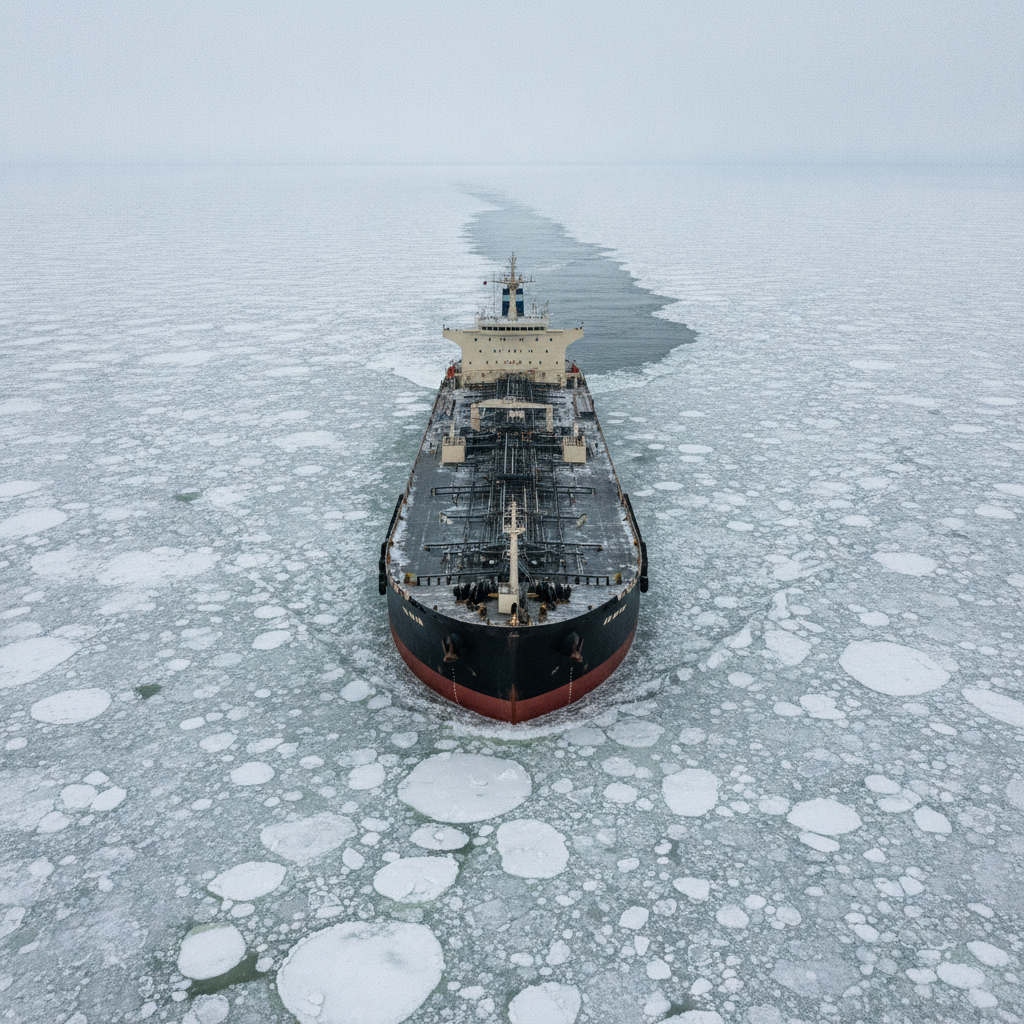
When does a non-ice-class tanker need an icebreaker? The shoulder-season decision
Drift ice, no icebreaker, a non-ice-class tanker on the berth window. How operators decide when unescorted transit is defensible – POLARIS, Baltic practice, ice advisors, and the metocean discipline the decision deserves.
The DP incidents you never hear about: why concealment still pays
DP position-loss incidents keep repeating not because the technology is immature, but because concealing them is still rational. A failure analysis of the industry's broken learning loop – and what operators can do about it.
MAIB annual report 2025: why survey vessel operating failures keep recurring
The MAIB's 2025 annual report tracks open recommendations. We analyse the recurring vessel-operation failure chains on survey vessels and how to break them.
Offshore Geomatics Foundation Certificate · October 2026
Turn reading into certified competence
Most of the failures we analyse trace back to fundamentals nobody verified. The Foundation Certificate is a structured way to close exactly those gaps.
Early-access list gets 40% off at launch. No spam – the waitlist is only ever used for the certificate. What the certificate covers →