Executive Summary
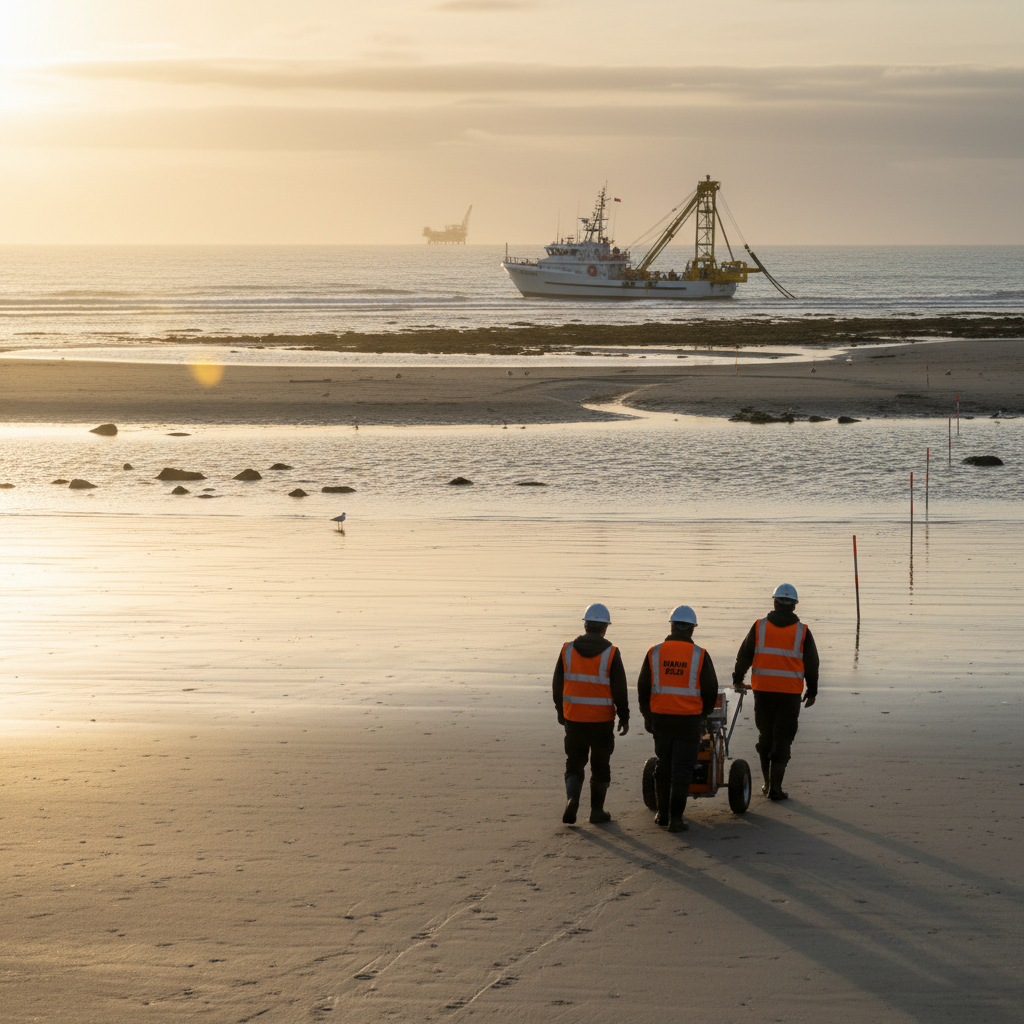
Deformation monitoring on offshore platforms confronts a problem every survey manager knows: determining what moves relative to what. The platform settles. Wellheads expand. The seabed compacts. Getting this wrong cost Ekofisk $1bn. Getting it right demands integrating GNSS, precise levelling, acoustic positioning, and subsea pressure sensors into a single coordinate framework – and understanding which measurements answer which questions.
The Question That Matters
You’re on the platform deck, facing a real problem: the wellhead has risen 40 mm above the reference point on the platform leg. What on earth has happened? Is it thermal expansion, platform settling, or seabed compaction? Perhaps a combination of all of them? This isn’t just theory; a mistake here could cost you millions you’ll never know when you’re out of pocket, or worse, your pipelines could burst because you missed a major accident. We’ve seen both happen far too often. Monitoring deformation at sea is a completely different challenge than on land. On land, you assume the seabed doesn’t move (or hardly moves at all) – here, nothing is stable. Platforms settle – not always obviously – wells behave in their own way, and the seabed has a slippery texture and compacts unpredictably, depending on the formation. You have to compare everything with everything else and then sort out the confusion. That’s where geodesy comes in. We are essentially the only ones who can integrate your surface measurements with your underwater sensors and borehole measuring devices into a single system. But (and this is a very important “but”) only if you truly understand what each individual device is indicating.
What Happened at Ekofisk
Take the Ekofisk field in the Norwegian North Sea. It’s a prime example of how to do something right (or wrong). It’s November 1984, and the operators discover that the seabed is subsiding. Before they can cry “Oh no!”, the subsidence zone has deepened to 2.5 meters and stretched for 6 kilometers. Depending on whom you believe, the subsidence rate fluctuated wildly between 192 mm/year and 762 mm/year between 1982 and 1985. A classic case of conflicting data: radar measurements showed 500 mm/year between 1980 and 1984. Reliable? Hard to say. The cause: highly porous chalk layers that began to collapse as pore pressure decreased – the chalk sank, and the seabed followed. The platform, on its massive concrete supports, simply followed. The end result? In 1987, the entire platform was raised. And then what? Around a billion dollars. Painful. But Valhall, in the same area with the same Cretaceous geology, recorded 500 mm of subsidence in the first three years alone. And then? Stabilization at 250 mm/year. That can’t be fixed with a few mobile measurements. Valhall installed permanent seismic networks over an area of more than 45 km² and conducted fiber-optic seismic monitoring in boreholes. Looking at other Norwegian fields, the picture is as follows:
- Sleipner: 20.8 mm/year
- Troll: 12.17 mm/year
- Midgard: between 10 and 75 mm/year
- Ormen Lange: 4.83 mm/year
- Snøhvit: only 1 mm.
These aren’t small, short-term projects. No, these are large-scale projects where understanding the deformations is a matter of life and death. And that’s precisely what it’s all about. This is the question everyone should ask themselves: “Do we really understand the ground we stand on?” Often the answer is a categorical “No”.
The Methods: What Actually Measures What
GNSS: Your Absolute Reference
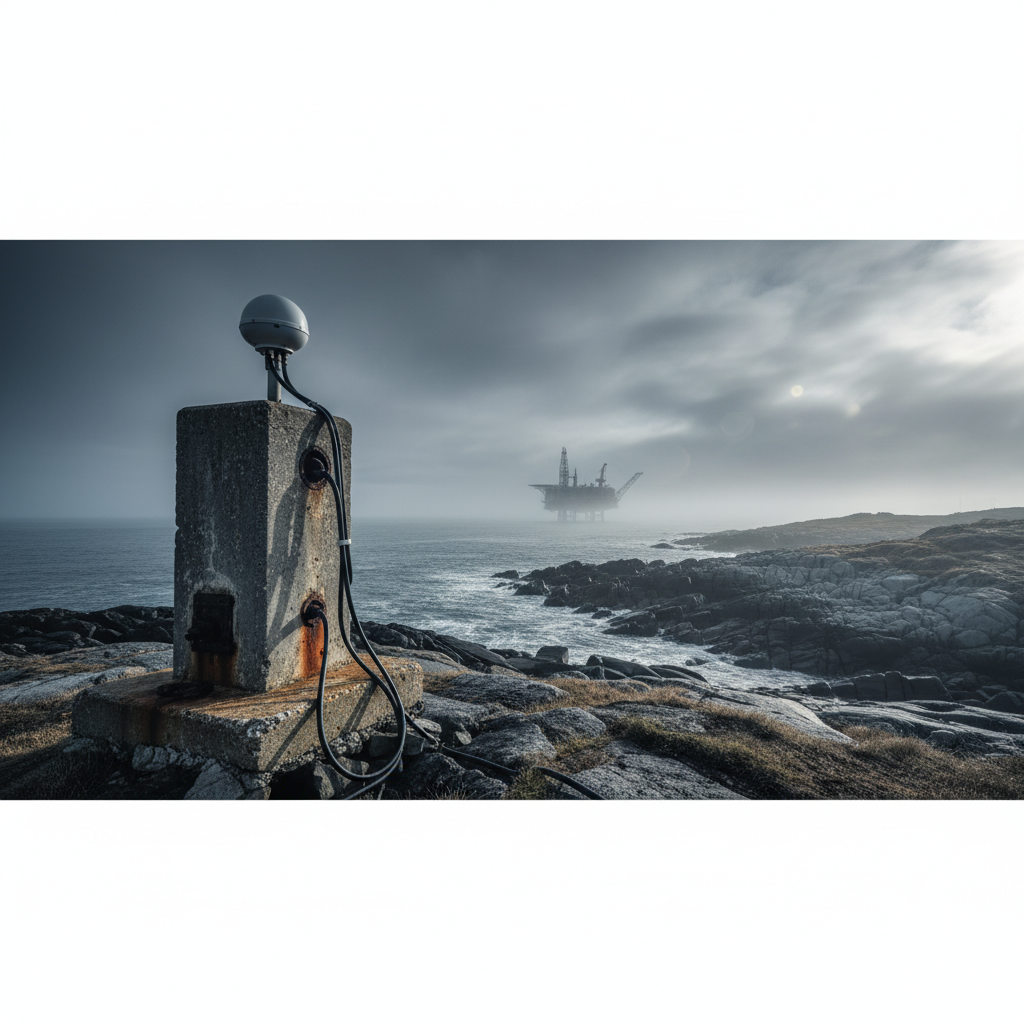
GNSS is your global anchor. It gives you the absolute position of your platform on a global scale. With proper application of PPP or ambiguous methods, you can achieve an accuracy of 3–4 mm horizontally and about 7 mm vertically for daily calculations. This is your baseline. However, don’t expect information about the differential movement of individual platform elements. A wellhead, for example, might expand by 30 mm, while GNSS shows a total platform settling of 15 mm. Both are correct— GNSS simply doesn’t capture everything. Are there limitations? Yes, there are. Metallic structures cause multipath propagation – often overlooked – poor sky illumination makes data acquisition difficult, and problematic ionospheric conditions – particularly in the north and south – reduce accuracy. However, it’s your primary source for absolute vertical movement when everything else depends on local reference points. Guoquan Wang’s 2024 study in the Gulf of Mexico clearly demonstrated that regional reference points alone are sufficient to ensure sub-centimeter accuracy in long-term monitoring. With appropriate data processing, offshore reference stations are no longer detectable; ### Precise Levelling: The Relative Workhorse
Digital levels are your indispensable tool for determining relative heights. We’re talking about an accuracy of 0.3–1.0 mm/km. However, they don’t provide absolute height values, but only height differences. And considerable ones at that. Your task? To ensure the stability of the reference points, install them on the main supporting structures, establish leveling loops to the starting point, and carefully analyze the loop closures. If the closures are outside the permissible tolerances, an error has occurred – either in the measurement itself or in the movement of the reference points. We proceed very meticulously: We conduct measurement campaigns quarterly on all platforms showing signs of deformation. We compare each point with the baseline and analyze the statistical data – Pelzer or Baarda tests provide initial indications. The result? You learn that the mouth of borehole A has shifted by 8 mm relative to the mouth of borehole B relative to reference point C – but the absolute positions remain unclear.
Tachyometry: 3D Relative Positioning
Robotic total stations like the Leica TS60 or Trimble S9? These instruments capture the position of prisms on wellheads, pipeline supports, and steel structures – with an angular accuracy of approximately ±0.5 inches and a distance accuracy of ±0.6 mm + 1 ppm. You get 3D displacement vectors, not just vertical displacements. Install prisms on:
- Wellhead flanges (pipe/wellhead position)
- Pipe supports (detection of bends every 5–10 meters)
- Valves (verification of equipment movement)
- Steel structures (detection of structural deformation)
Automate this process; quarterly manual measurements? A missed opportunity. Automated scans every 4 hours correlate with production changes, weather conditions, and even tides. ### Subsea Pressure Sensors: The Absolute Seafloor Reference
Want to know if the seabed has shifted? Then it’s time to deploy underwater pressure sensors like Sonardyne Fetch, Valeport, or Aanderaa. These devices continuously measure pressure and transmit the data every 3–9 months. Converting pressure to depth is straightforward: a change in pressure corresponds to a vertical movement of the seabed. An accuracy of 10 mm/year is desirable; Sonardyne achieved this in 2019/2020 with 75 devices in Lake Ormen-Lange. The sensors have a lifespan of over ten years. Once installed, they collect data for the entire lifespan of the platform. This does not apply to repeated survey vessel deployments. A tip: Distribute the sensors throughout the entire subsidence area. Don’t limit yourself to just a few sensors in close proximity. The compaction creates a central depression above the reservoir, and three sensors alone are insufficient.
Hydrostatic Levelling: Continuous Relative Height
Hydrostatic leveling allows for submillimeter accuracy between measurement points. Imagine continuously comparing the borehole head height to fixed structural reference points. Consider Rijkswaterstaat’s 12 km pipeline installation that monitored the Wadden Sea until 2003. Laboratory accuracy: 1 micrometer; field accuracy: 1–10 mm. Continuous data is beneficial; however, sensitivity to temperature variations makes recalibration difficult. We observed a drift of 5 mm within six months due to temperature changes alone. Use the method judiciously – continuous data can be lifesaving between large measurement campaigns.
Downhole Measurements: Going to the Source
You install caesium-137 markers in the borehole every 10 metres. Data is collected regularly, changes in distance to the markers are measured, and with some calculations, an accuracy of 1 mm is achieved. Instruments for monitoring formation compaction use four gamma-ray detectors and offer an accuracy of 2.54 mm at a depth of 9 metres. This makes it possible to determine where compaction occurs within the formation. Formation compaction or subsidence of the overlying rock? Different causes, different solutions. Analysis of casing deformation? At 12 mm per casing, somewhat less accurate, but at least no radioactive sources are required.
The Conductor Growth Problem
The thermal production process in the Bohai Gulf illustrates this: The wellhead rises by 4–5 cm during steam injection. The heat expands the steel pipe – and, unsurprisingly, the free pipe length between the cement layer and the surface is critical for the overall expansion. Let’s look at the figures: The coefficient of thermal expansion for steel is approximately 12 × 10⁻⁶/°C. The production temperature is 150–200 °C, and the pipe length is 2,000–3,000 meters. The calculation is: ΔL = α × L × ΔT. We obtain ΔT = 150 °C and L = 2500 m. This corresponds to a thermal expansion of 45 mm. This matches the processes observed in the Bohai Gulf. Why is this important? The wellhead moves relative to the bottom of the well. This puts the pipelines connecting the wellhead to the reservoir under bending stress. Flange connections? They are subjected to shear forces. Material fatigue leads to displacements – similar to Christmas trees. At an expansion of 30 mm, the pipeline’s design limits are already largely reached. At 50 mm, failure is imminent – and yes, we’ve seen it happen. One operator discovered an expansion of 60 mm while pumping from a 180 °C hot well. The result was a 15 mm wide bend in the pipeline. Production had to be completely halted, the supporting structure redesigned, and continuous monitoring installed before operations could resume. How can such issues be detected? Through baseline measurements before production begins and subsequent regular checks; precise level measurements from structural reference points to the wellhead flanges. The measurement frequency should be determined based on the production temperature and the pumping rate.
Untangling the Movements
Here’s how it works:
Step 1: Establish absolute control points. Place GNSS receivers on the platform structure. Compare the data to an ITRF or regional coordinate system. You will obtain an absolute displacement vector of the platform – a typical result? “The platform is sinking 12 mm/year vertically and 3 mm/year horizontally to the northeast.”
Step 2: Measure relative displacements. Precise levelling and tachymetry from the control points to the monitoring points, especially statistical adjustment of the measurement network, will result in large displacements. Example result: “The wellhead of borehole 3 has risen by 18 mm relative to control point A. The wellhead of borehole 7 has sunk by 5 mm. The control points are stable.”
Step 3: Combine the results. The platform has sunk by 12 mm (GNSS), the wellhead of borehole 3 has risen by 18 mm relative to control point A – this corresponds to an absolute uplift of 6 mm. Wellhead 7 has subsided by 5 mm relative to the platform, resulting in an absolute subsidence of 17 mm.
Here’s our conclusion: Wellhead 3 is thermally rising while the platform is subsiding. Wellhead 7 is subsiding normally. Local compaction near the well is likely.
Step 4: Reviewing underwater data. Seabed pressure sensors are registering a subsidence of 15 mm. The platform has subsided by 12 mm; so what does this 3 mm difference mean? Either the platform structure is compressing (the hull is sinking to the seabed), or there is unusual differential movement at the base.
Step 5: Reviewing formation compaction. The wellhead monitoring shows a formation compaction of 20 mm. The surface subsidence is 15 mm; the ratio? 0.75. This is your compaction transfer coefficient – formation compaction to surface movement. The normal range, depending on the overlying formation, is between 0.5 and 0.9.
Here is the overall picture of the deformation: The formation is densifying, the seabed is subsiding – the platform is subsiding with it, and compression is also occurring. Most of the wellheads are subsiding along with the platform. One exhibits thermal growth, another local densification. Each of these elements answers the question. GNSS alone is insufficient, as is levelling. A complete system is needed.
What Clients Get Wrong
1. Assumption of the platform’s structural stability
The assumption that the control points on the lower deck are absolutely fixed is a major error. We have seen monitoring programs use them as absolute reference points and then be surprised when each borehole showed a “growth” of 15 mm/year. The control points have settled, the boreholes have settled, the entire structure has settled. Surprise! You are measuring relative to a moving reference point and therefore don’t get any relative movement. Classic case. The solution? GNSS on the structure. Indispensable for deformation monitoring. Without determining an absolute position, all relative measurements are pure speculation.
2. Monitoring Too Infrequently
Quarterly measurements on a platform exploring high-temperature formations are not optimal. They fail to capture short-term thermal effects. Imagine missing a sudden 20 mm rise in wellhead pressure over six weeks during a production ramp-up, only to observe an 8 mm drop a month later. While a quarterly measurement captures a net change of 12 mm, it misses the pressure peak and subsequent fall-off. This pattern, however, is critical for understanding casing friction and cement adhesion. Our recommendation? Automated monitoring. Use robotic total stations, continuous GNSS, or hydrostatic leveling for large boreholes. Manual measurements should be used to verify and survey the entire well network.
3. Ignoring Horizontal Movements
Leveling measurements only capture vertical displacements. Platforms, however, tilt, just like wellheads; pipelines connect fixed points – if these points shift horizontally, the pipelines bend. We observed the following: A platform with a vertical subsidence of 8 mm (normal), but a horizontal displacement of 25 mm in the northwest corner compared to the southeast – far from normal. The platform tilted, and the pipelines along the northwest-southeast axis buckled with tremendous force. Why? Because the horizontal displacement wasn’t measured, since “subsidence is a vertical phenomenon.” The solution: 3D monitoring, simple and straightforward. Use total station or GNSS at multiple points on the platform. Detect the tilt before it becomes visible.
4. No Subsea Reference
You see, if you measure platform deformation but ignore seabed subsidence, you won’t know the difference between platform and seabed subsidence. This distinction isn’t just theoretical – it’s critical for decommissioning planning, riser integrity, and understanding reservoir behavior. Submersible pressure sensors? Around £15,000 each. Installation can cost £50,000 —data collection? Expect another £20,000 per campaign. Over ten years? Perhaps £400,000 in total. But compare that to being caught off guard by 1.5 meters of seabed subsidence – and then having pipe blockages during decommissioning? Extremely frustrating. Our advice: Install seabed sensors during platform installation. Plan for a 20-year monitoring period. Budget for annual data collection as part of your operating costs.
5. Lack of integration between disciplines
Surveys provide measurements. But who needs them? Structural engineers for FEM models, petroleum engineers for geomechanical models, well technicians for thermal expansion analyses, and integrity management specialists for risk assessments. A classic problem. And what do we see? Geodetic measurement data sits in the surveying department’s database – and is ignored by everyone else.
Solution: Deformation monitoring data should be fed directly into SIM (Structural Integrity Management) according to the API RP 2SIM standard. Define alarm thresholds and automate the data flow. If the deformation reaches the yellow threshold (typically 5–20 mm/year vertical), technical expertise is required. Red threshold (>20 mm/year vertical)? This requires immediate investigation and, if necessary, production restrictions. If you’re not integrating this data, you’re doing something wrong.
Standards and Thresholds
To be clear: API RP 2A-WSD and API RP 2SIM establish rules for structural monitoring but do not define strain thresholds. Why? Because these are platform-specific and derived directly from the structural analysis.
| Parameter | Green | Yellow | Red |
|---|---|---|---|
| Vertical subsidence | <5 mm/year | 5–20 mm/year | >20 mm/year |
| Settlement differential at wellhead | <2 mm | 2–5 mm | >5 mm |
| Platform inclination | <1:1000 | 1:1000–1:500 | >1:500 |
| Thermal expansion at wellhead | <10 mm | 10–30 mm | >30 mm |
These values are not legally binding – they are thresholds based on a risk assessment considering the structural capacity and equipment tolerances. Admittedly, your platform’s metrics may differ, but the most important thing is to set thresholds before problems arise, not after. ISO 19901-9? While it deals with managing structural integrity, the details are left to industry giants like API and NORSOK. For example, NORSOK standard N-005 sets the rules for the Norwegian continental shelf – arguably the strictest surveying regime for marine areas worldwide. Then there’s IOGP report 624-02-01, which covers the calibration and verification of geodetic systems. Make sure you adhere to these. We’ve seen projects where GNSS receivers weren’t even verified against known coordinates. Claiming millimeter-level accuracy without proving it? That’s unacceptable.
What Actually Works
Let’s get straight to the point: Fixed GNSS are the best choice for platforms in calm waters such as the Gulf of Mexico, West Africa, or Southeast Asia. But what about harsh conditions like the North Sea in winter? That’s a different story – downtime can completely wipe out data coverage. For typical platforms without known sudden temperature fluctuations or subsidence, quarterly precision leveling campaigns combined with annual total station surveys are ideal. They allow you to detect slow deformations before they get out of control. Do you operate platforms in highly compacted formations or use high-temperature boreholes (e.g., chalk or loose sand)? Then continuous automated monitoring is the best option. Consider robotic total stations, fixed GNSS, hydrostatic leveling – whatever is needed. Deploy seabed pressure sensors on platforms where seabed compaction is a known problem or mandated by law (e.g., in the Dutch North Sea or on the Norwegian shelf). Our advice? Install them from the start. Annual or semi-annual data collection is optimal. And then there’s well monitoring; common sense dictates prioritizing, not monitoring every single well. Focus on a sample that represents different formations and production conditions. Trying to do everything at once? That’s simply uneconomical. Integration with SIM is essential. Your deformation data is worthless if left unused. Feed these measurements into integrity management systems. Identify triggers and analyze trends quarterly. Update your structural models as soon as you detect deformations that exceed predictions. From our many years of experience, we know: Be vigilant. Ignoring is dangerous.
The Geomatics Role
We create the coordinate system upon which all others are built. Petroleum engineers model soil compaction, structural engineers analyze platform behavior, and drilling engineers focus on thermal behavior. And us? We measure what actually happens. Our true strength lies in integrating above- and underwater space into a single coordinate system. GNSS enables absolute positioning and precise leveling, while tachymetry reveals relative movements on deck. USBL / LBL positioning extends the coordinate system to the underwater world. Seabed sensors provide absolute underwater positioning, and wellbore oscillators precisely determine reservoir deformation. These systems use different sensors with varying physical properties and sources of error. Their coordination demands the highest geodetic precision: clearly defined control points, transformation parameters, and proof that uncertainties are adequately controlled through reliable statistical tests. If this is achieved, the foundation for all other engineering disciplines is laid. If it is not, all subsequent areas are based on questionable geometries.
Practical Recommendations
Before platform installation:
- Design a FEED (Front-End Engineering Design) monitoring system.
- Clearly mark control point locations on the design drawings.
- Design GNSS antenna mounts in advance and incorporate them into the design.
- Ensure budget is allocated for the use of underwater sensors.
- Define alarm thresholds based on sound structural analysis.
During commissioning:
- Conduct baseline studies before production begins.
- Double-check the stability of every control point – no exceptions.
- Commission automated systems and ensure the data meets requirements.
- Ensure integration with SCADA/SIM systems.
During operation:
- Strictly adhere to the monitoring plan.
- Process and analyze data promptly – e.g., within 48 hours of receipt.
- Investigate yellow alert level breaches within 30 days. Ignoring them is not advisable.
- Update structural models annually with actual deformation data.
- Use this data to analyze production data and understand the actual processes.
And when does deformation exceed predictions?
- Validate measurements (conduct further studies, try different methods).
- Identify the cause of the deformation – reservoir, seabed, structure, thermal – whatever it may be.
- Assess the impact on facilities and pipelines.
- If structural integrity is at risk, consider reducing production.
- Increase monitoring if the situation appears critical.
This is not mere theory – Ekofisk learned the hard way about the ineffectiveness of monitoring. Valhall, on the other hand, demonstrates why integrated systems are not just buzzwords, but a necessity. Numerous other areas range from manageable problems to outright disasters. Don’t wait until something goes wrong to use the tools at your disposal. Monitoring costs hundreds of thousands; no monitoring? A nightmare worth billions.